
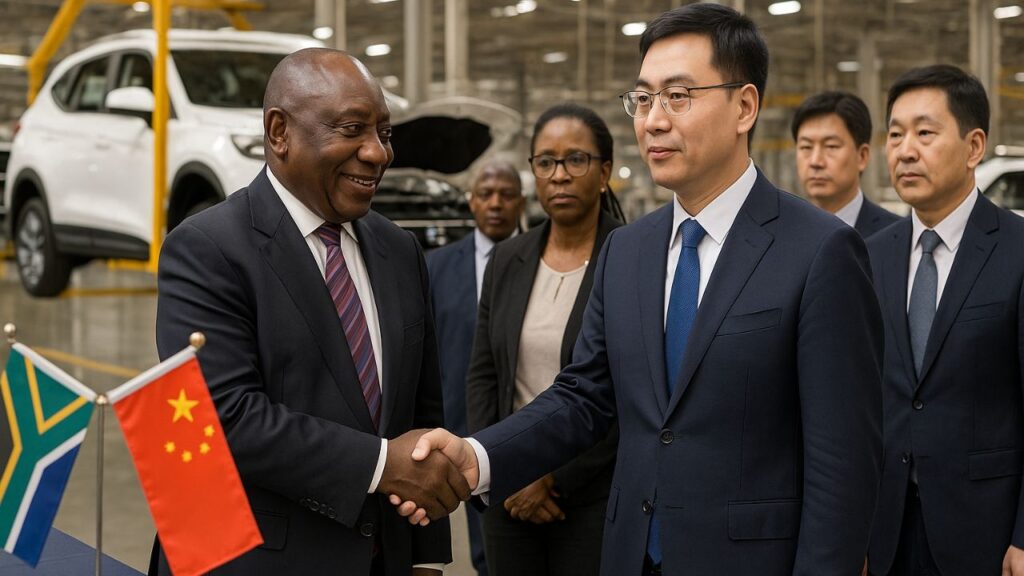
Chinese automakers – South Africa is actively engaging with leading Chinese automakers in a strategic effort to enhance local vehicle production and strengthen its automotive sector. The South African government, in collaboration with industry stakeholders, is exploring partnerships that could bring advanced manufacturing technologies and investment into the country. This initiative aims to not only increase domestic vehicle output but also create thousands of new jobs, stimulate economic growth, and reduce dependency on imported vehicles. By leveraging China’s expertise in automotive production and innovation, South Africa hopes to modernize its manufacturing facilities, introduce electric and hybrid vehicle technology, and boost local supply chains. Experts believe that successful collaboration could position South Africa as a regional automotive hub, attracting further investment from other global players. This move aligns with the country’s broader industrial development goals and ambitions for sustainable economic growth. For more details on this initiative, you can refer to the Reuters report.

Government Incentives and Policy Support for Local Production
The South African government is providing strong policy support and incentives to encourage foreign automakers to invest locally. Initiatives such as tax breaks, subsidies for electric vehicle production, and infrastructure development plans are part of a comprehensive strategy to attract Chinese automakers. These measures aim to make local manufacturing more competitive, reduce production costs, and ensure sustainable industrial growth. Additionally, the government is actively facilitating training programs to equip local workers with the necessary skills for modern automotive production. This will help ensure that technology transfer and knowledge sharing are effective, resulting in a highly skilled workforce ready to support large-scale vehicle manufacturing. Analysts suggest that combining policy incentives with Chinese investment expertise could transform South Africa’s automotive landscape. More information on government automotive policies can be found on the BusinessTech automotive section.
 Online Retail in South Africa to Cross R130 Billion in 2025 – Trending on YouTube & Ecommerce Buzz
Potential Impact on Employment and Local Economy
Boosting vehicle production through partnerships with Chinese automakers is expected to create significant employment opportunities across South Africa. From factory assembly lines to parts suppliers and logistics, a surge in vehicle production could stimulate multiple sectors of the economy. Small and medium enterprises in the automotive supply chain could benefit from increased demand for components and services. Experts predict that, alongside direct employment, there will be a positive ripple effect on the economy, with local communities benefiting from increased incomes and improved infrastructure. This strategy aligns with the national plan to reduce unemployment and strengthen industrial capacity. For a detailed analysis of economic impacts, you can visit Engineering News.
 Weather South Africa Warning: Heavy Rains Forecasted in Western Cape – Residents Rush to Check Google Weather Updates
Collaboration with Chinese Automakers: Models and Technology Transfer
South Africa is particularly interested in collaborating with Chinese automakers to gain access to the latest vehicle models and production technologies. These collaborations could involve joint ventures where South African manufacturers work alongside Chinese firms to produce popular vehicle models locally. Technology transfer is a crucial aspect of these partnerships, allowing local engineers and technicians to learn advanced production techniques, automation systems, and quality control processes. Over time, this knowledge will enhance domestic capabilities and potentially lead to the development of new, locally designed vehicles suited for African markets. Companies like BYD Auto and SAIC Motor have already shown interest in exploring joint production opportunities, signaling promising prospects for the South African automotive industry.
 Springboks Smash All Blacks 43–10 in Record Rugby Win – Fans Celebrate on Betway & Hollywoodbets
Future Prospects and Sustainability Goals
The push to collaborate with Chinese automakers also supports South Africa’s commitment to sustainability and green energy in transportation. By introducing electric vehicles (EVs) and hybrid technologies, local production can reduce the environmental footprint of the automotive sector. Government policies and private sector commitments are increasingly focusing on sustainable practices, including renewable energy-powered factories and efficient supply chains. Long-term, these partnerships are expected to enhance South Africa’s reputation as a hub for modern, eco-friendly vehicle production in Africa. Investors and stakeholders are closely monitoring progress, anticipating a boost in both domestic consumption and export potential. For further insights into sustainable automotive production, refer to CleanTechnica.

